Finished card drawing

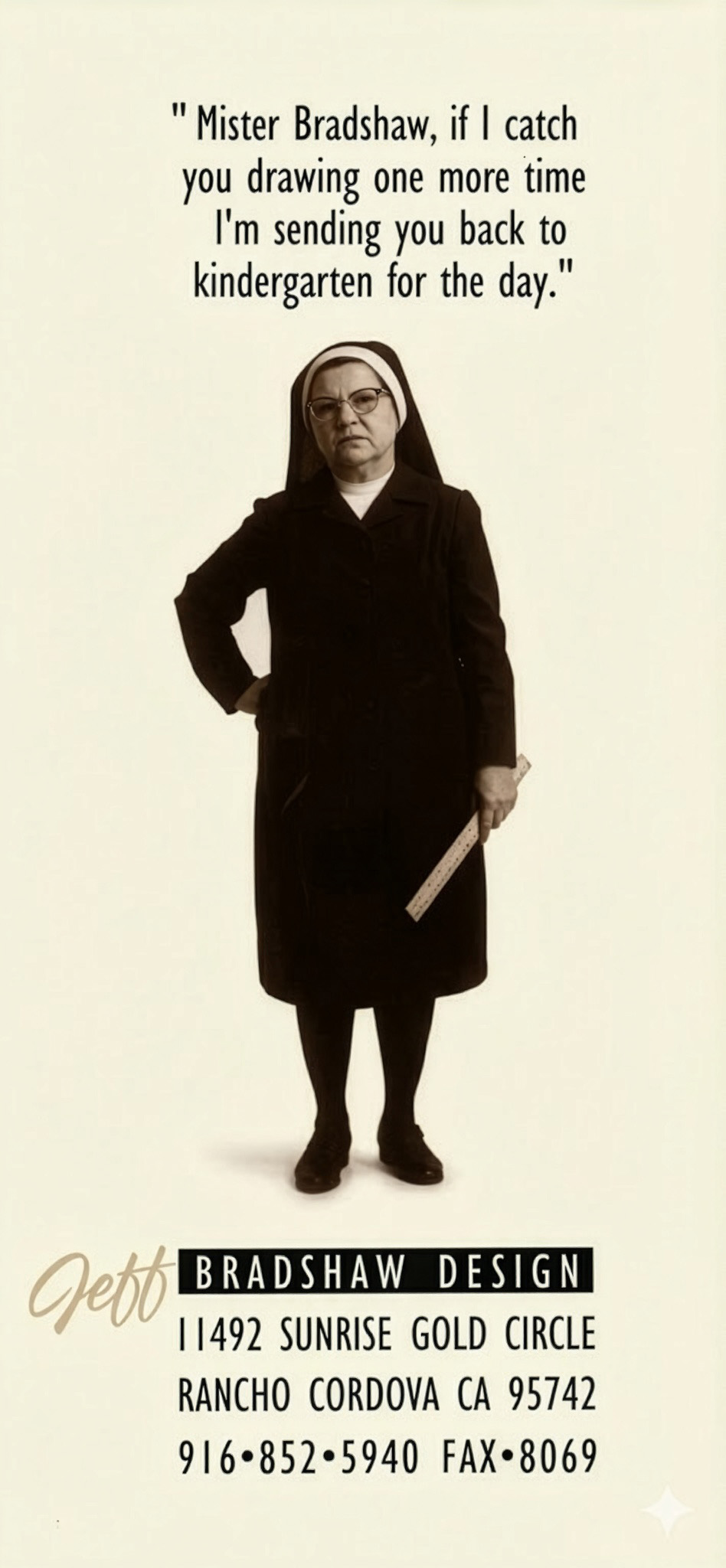
"I never stopped."

Jeff Bradshaw

From Rapidograph Pens to Prompting AI

Making people stop and look since 1976

1976

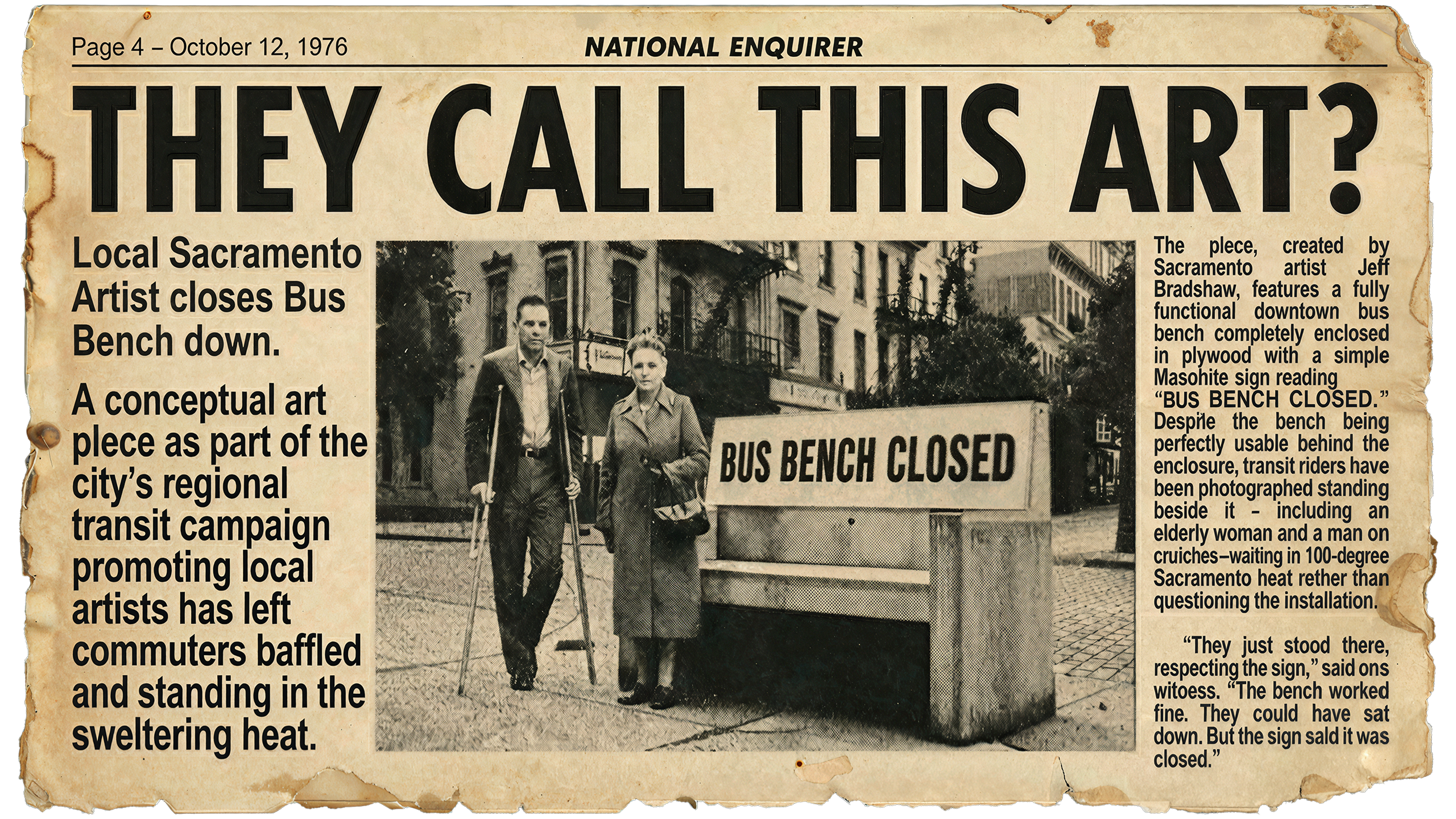
The Bus Bench

Bus Bench Sign — 1976

Before computers. Before the internet. Before anyone imagined a world where machines could create, there was a kid with a Rapidograph pen and an idea that wouldn't fit inside the lines.

The bus bench was the first canvas — a place where passersby couldn't look away. It was advertising at its most primal: a message, a surface, and the unshakable belief that if you made something bold enough, people would stop. They did. And the work caught the attention of the National Enquirer, turning a local sign into a story that traveled far beyond the bench.

That was the beginning. Not of a career — of a pattern.

1980

The Business Card

When you're Creative Director at a company called Buffalo Chips — a snack food company with everything to prove — you don't hand out ordinary business cards. You print them on potato chips.

The concept was simple and impossible to ignore. It won Ad Club awards. It got covered in trade press. And it set the tone for everything that followed: take the expected and make it unforgettable.

"Without Bradshaw's innovative concepts, Buffalo Chips would have remained just another regional snack." — Snack Food Magazine
1982 – 1985

The Gaming Pioneer

Gridware was the bet on a new frontier. The mission: take beloved arcade titles — Tapper, Spy Hunter, and others — and port them to home computers. At its peak, the operation pulled in $30,000 a month. The arcade-to-home pipeline was real, and it was working.

Then the bottom fell out. The video game crash of '83–'85 didn't just slow things down — it collapsed the entire market. Revenue dropped from $30K to $5K almost overnight. Studios closed. Publishers vanished. An industry that seemed invincible proved it wasn't.

But the instinct that built Gridware — the ability to see where technology and culture were about to collide — that didn't disappear. It just waited for the next collision.

Late 1980s

Interactive Television

Thirty years before Netflix. Before streaming was a word anyone used outside of fishing. Before "interactive content" meant anything to anyone — there was VTN.

A $20 million venture to build something that didn't have a name yet: interactive television. Viewers could engage with programming, make choices, respond in real time. The technology was ahead of the infrastructure. The bandwidth wasn't there. The audience wasn't ready. The vision was right; the timing was impossible.

The project ultimately couldn't outrun the limitations of its era. But the interfaces designed, the interaction models prototyped, the fundamental question of "What if the audience could participate?" — all of it would become the foundation of modern streaming and interactive media decades later.

2008 – 2022

Corporate Mastery

After decades on the bleeding edge, a different kind of proving ground: the enterprise. At CGI — one of the world's largest IT and consulting firms — the work shifted to a scale few creatives ever touch.

Over fourteen years, the creative output contributed to more than $1 billion in contract wins. Federal agencies. Fortune 500 clients. Proposals and presentations where the stakes were measured in hundreds of millions and the margin for error was zero.

This wasn't startup energy or scrappy innovation. This was precision. Understanding how to translate complex technical capabilities into narratives that moved decision-makers. Learning that at the enterprise level, design isn't decoration — it's strategy.

The Rapidograph kid who once painted bus benches was now shaping how billion-dollar deals got won.

2025

AI Acceleration

The pattern repeats. A new technology arrives that most people don't understand yet. The tools are primitive but the potential is unmistakable. The skeptics say it's a fad. The early adopters know better.

Fifty years ago it was a pen and a bus bench. Then it was arcade games on home computers. Then interactive television before broadband existed. Now it's artificial intelligence — and the question isn't whether it will transform creative work, but who will be ready when it does.

The same instinct that recognized every previous wave is now fully engaged with AI. Not as a novelty. Not as a replacement for craft. As the next medium — the next canvas — for someone who has spent half a century finding new ways to make people stop and look.

The Through-Line

Every era had its doubters. Every medium had its limitations. Every crash, every collapse, every "too early" was followed by the same response: adapt, learn, build again.

The thread that connects a hand-painted bus bench to an AI-generated campaign isn't technology. It's the eye. The instinct for what will make someone pause. The refusal to do things the expected way. The understanding that tools change but the job never does: make people stop and look.

Five decades. Every major creative technology shift. Still here. Still looking forward.

Let's Talk

Available for creative direction, AI consulting, and projects that refuse to be ordinary.

Get in Touch